Featured event · Ujjain
Simhastha Kumbh · Ujjain · 2028
Guru keeps his seat in Simha, and the Kumbh crosses from the Godavari to the Shipra. Through the spring of 2028, Mahakal's own city holds the tirtha — and wherever you are, the river's morning reaches you.
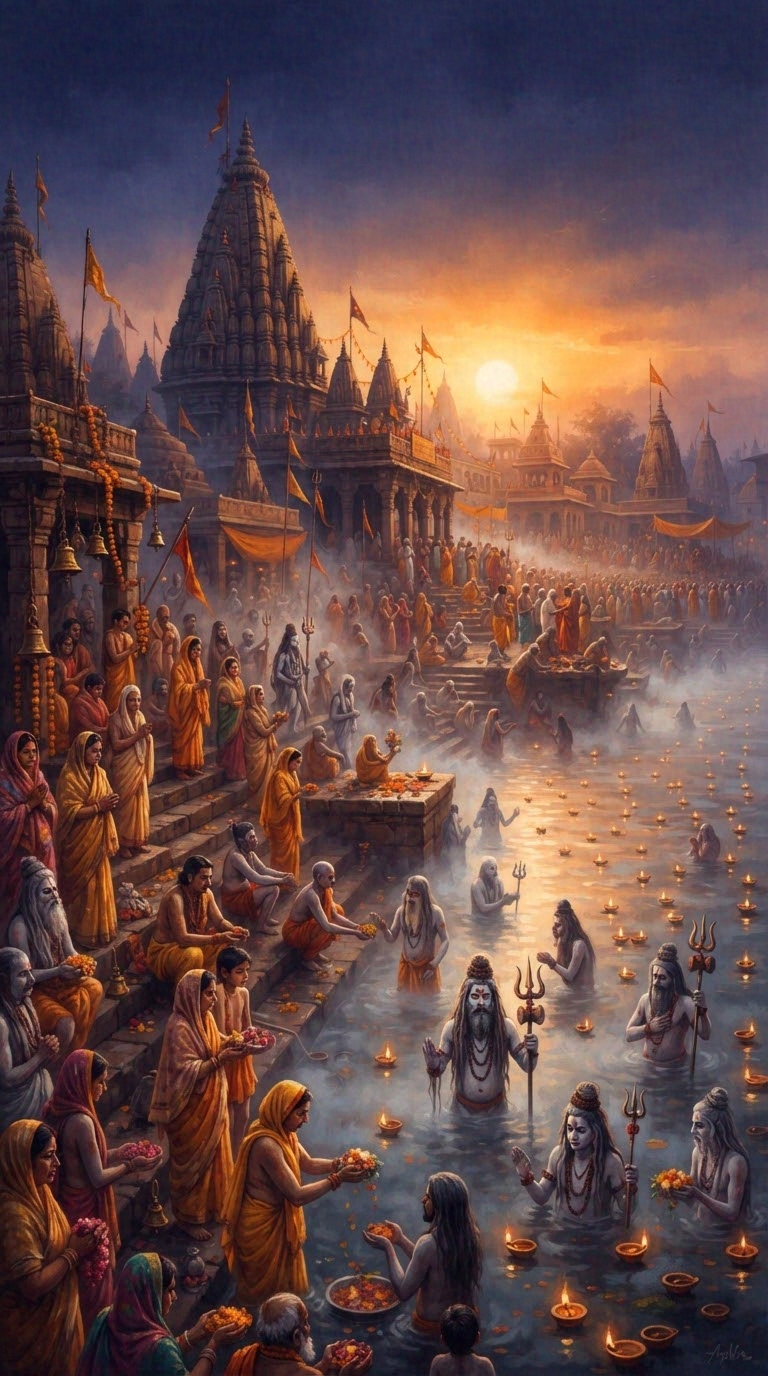
The Simhastha comes to Mahakal's city
Once in twelve years, Guru — Brihaspati, the slow, bright teacher among the grahas — takes his seat in Simha rashi, and that seating summons the Kumbh to the Shipra. The gathering here has carried its own name for centuries: the Simhastha — "seated in the Lion." Your panchang marks Guru's unhurried walk through the rashis every day; this is the season that walk brings the tirtha its appointment. The last Simhastha here was in 2016; the next season opens in the spring of 2028.
And the city that receives it is not an ordinary city. Ujjain is Avantika, counted among the seven moksha-puris — the cities where liberation itself is said to be given — and it is Mahakal's own seat: the Jyotirlinga of Mahakaleshwar stands here, Shiva as the Lord of Time. A Kumbh is always a meeting of sacred time and sacred water. In Ujjain, uniquely, the Lord of Time himself keeps the ghat.
Four tirthas share the Kumbh among themselves — Prayagraj, Haridwar, Nashik, Ujjain — each keeping its own appointment with the heavens in turn. In 2028, the turn is the Shipra's.
The dates on these pages are declared by the mela authorities and remain provisional until officially confirmed.
Dates & calendar
| Observance | Date | Weekday | Tithi / reference | Status |
|---|---|---|---|---|
| Simhastha begins — the mela's season opens on the Shipra | Monday | Chaitra Shukla Pratipada — Varsha Pratipada, the Vikram-Samvat new year | Provisional | |
| First Amrit Snan | Sunday | Chaitra Purnima | Provisional | |
| Second Amrit Snan | Thursday | Akshaya Tritiya (Vaishakha Shukla Tritiya) | Provisional | |
| Third Amrit Snan — the principal snan | Monday | Vaishakha Purnima, on a Somvar | Provisional | |
| Simhastha concludes | Saturday | — | Provisional |
These dates are declared by the mela authority and remain provisional until officially confirmed — shown, not asserted.
When the Shipra fills: the Snan Calendar
The Simhastha keeps a season of two months on the Shipra — from late March into late May of 2028 — and the season opens on a day Ujjain has particular right to: Chaitra Shukla Pratipada, the new year's day of the Vikram Samvat, the era that tradition ties to Vikramaditya, Ujjain's own remembered king. The city that gave the calendar its year opens the mela on the year's first morning.
Within that season, the river's heart beats three times, on the Amrit Snan days — the name the akharas themselves restored in 2025, for what was formerly called Shahi Snan. Each day is holy for a reason the calendar only points to: the tithi. The arc runs Purnima to Purnima. The first Amrit Snan falls on Chaitra Purnima, the full moon that closes the year's first month. The last and principal snan falls on Vaishakha Purnima — and in 2028 that Purnima arrives on a Somvar, Shiva's own day, one of the very conditions the old Simhastha yoga names. Between them comes the middle snan, which tradition here has kept on Akshaya Tritiya — the undiminishing third of Vaishakha, the tithi of 2016's second snan.
These dates are declared by the mela authority and are provisional until officially confirmed; if a date moves, this page will say so plainly.
Between the Amrit Snans, the parva snan days follow the panchang — and 2028 sets a rare one inside the season: a Somvati Amavasya, the dark moon of Vaishakha falling on a Monday. The app's own engine will keep the parva days for you.
On a snan day, the holiest window opens in Brahma muhurta, before the sun has touched the water. The akharas descend first, in an order of precedence kept across generations; the public enters after. To stand back while the standards pass down to the river is not waiting — it is the first act of your own snan. And wherever you are, the river's morning reaches you: the tithi rises over your own horizon, and a sankalpa taken with her name is a snan the tradition itself honors.
The declared days:
- Mon 27 Mar 2028 — Simhastha begins · Chaitra Shukla Pratipada (Varsha Pratipada)
- Sun 9 Apr 2028 — First Amrit Snan · Chaitra Purnima
- Thu 27 Apr 2028 — Second Amrit Snan · Akshaya Tritiya
- Mon 8 May 2028 — Third Amrit Snan (principal) · Vaishakha Purnima, on a Somvar
- Sat 27 May 2028 — Simhastha concludes
The churning, the drops, and why the water remembers
The Bhagavata recounts that the devas and the asuras once churned the ocean of milk together, seeking the amrit — the nectar of deathlessness. Mount Mandara was their churning rod; Vasuki, king of serpents, consented to be the rope. When the mountain began to sink into the deep, Vishnu descended as Kurma, the great tortoise, and bore its whole turning weight upon his back — the Lord becoming the still foundation beneath the world's labor.
And before the nectar, the poison. Out of the churning rose the Halahala, a darkness fierce enough to scorch the three worlds, and no one — deva or asura — could stand before it. It was Shiva who, out of compassion for every being, gathered it into his palm and drank — and held it in his throat, letting it travel no further. Hold that image a moment, because in Ujjain it is not a distant one. The one who took death itself into his throat and mastered it is enthroned in this city as Mahakala — the Lord of Time, before whom time and death themselves are servants. The Simhastha gathers, of all places, in his courtyard.
The churning went on, and at last Dhanvantari rose from the waves, luminous, bearing in his hands the kumbha — the pot of amrit. It is from this pot that the Kumbha Mela takes its name.
The tradition cherished at the Kumbh holds that as the pot was carried from the churning, four drops of amrit fell upon the earth — at Prayagraj, at Haridwar, at Nashik, and here, upon the Shipra at Ujjain. And it holds that when the grahas return to their remembered places, the waters at those four tirthas become, for those days, what fell into them. The rivers remember.
At each tirtha the remembering has its own sign, and Ujjain's is the most exacting of the four. Here the tradition watches for Guru seated in Simha while Surya stands in Mesha, in the month of Vaishakha. The elders of this kshetra preserve a fuller reckoning still: a list of conditions — Vaishakha's bright fortnight, the full moon, the Moon answering from Tula in Swati, a Somvar, the Avantika tirtha itself — that all converge on one day, the Vaishakha Purnima of the principal snan. This is why the word "Simhastha" is itself a small act of precision: the gathering is named not for a king or a place but for where Guru sits. It belongs to the same sky your daily panchang reads. This is not an event you attend; it is a rhythm you are already inside.
And why does the snan purify? Begin with the word the tradition chose. A tirtha is a ford — a shallow place in the river of existence where the far shore comes near enough to touch. The Shipra is no ordinary water even on ordinary days: locally it is said her very name, Kshipra — "the swift one" — remembers how quickly she carries away what is placed in her. On an Amrit Snan day, three sanctities meet in one place: the kshetra, the sacred time the grahas have opened, and the assembly of sants and akharas gathered on the banks. Into that confluence the devotee steps — but the step itself is made of two things the water cannot supply: sankalpa, the intention spoken and meant, and shraddha, the trust that offers it.
The elders put it simply: the Shipra can carry away what you place in her — but only what you truly place. The outer bath and the inner bath are taken together, or neither is taken at all.
The akharas: the orders that carry the standard
Before the crowds, the akharas. An akhara is not a "sect of holy men"; it is a monastic order — a lineage with its own deity, its own standard, its own discipline of body and spirit, formed in ages when renunciants also had to be defenders of dharma. Thirteen of them are recognized today, and they are the spine of every Kumbh: seven Sanyasi akharas of the Shaiva tradition — Mahanirvani, Niranjani, Juna (the largest), Atal, Avahan, Agni, and Anand — whose consolidation tradition attributes to Adi Shankaracharya; three Vaishnava (Bairagi) Anis — Nirvani, Nirmohi, and Digambar; two Udasin akharas — Bada Udasin and Naya Udasin; and one Nirmal akhara — the Nirmala, a panth distinct from the Udasin lineage. They speak together through the Akhil Bharatiya Akhara Parishad, and it was this body that in 2025 set aside the old courtly words: the royal bath became the Amrit Snan — named for the nectar, not for kings — and the grand entry procession, formerly Peshwai, became the Chhavni Pravesh, the entering of the camps.
The Chhavni Pravesh is many devotees' first sight of the Simhastha: an akhara arriving in state, its ishta-devata borne ahead, its standard raised, its sants — including the Naga sadhus, ash-clad renunciants whose austerity is among the oldest continuously kept disciplines on earth — moving through Ujjain's streets to their appointed camps by the river. On the Amrit Snan mornings the order reverses: from the camps down to the water, in a precedence kept across generations.
Honesty is also a form of reverence, so let the history be told plainly. Ujjain's sanctity is ancient beyond counting — Avantika is praised in the puranas, and Kalidasa sang of Ujjayini's glow centuries before most cities now on the map existed. The Simhastha in its present form, as a Kumbh of the akharas on the Shipra, took shape in the eighteenth century under the Maratha rulers of Ujjain, who invited the sadhus' orders to gather here as they did at Nashik. A tradition does not need an invented antiquity; that the orders have kept this appointment, twelve years upon twelve years, is glory enough. The last keeping was in 2016; the next is now.
Avantika: where time itself keeps a temple
Ujjain is not "a Kumbh venue." It is Avantika — one of the seven moksha-puris, a city the tradition counts as a giver of liberation — and the Simhastha unfolds across a sacred geography that was complete long before any mela came to it.
Mahakaleshwar. At the city's heart stands one of the twelve Jyotirlingas: Mahakaleshwar, Shiva as Mahakala, the Lord of Time. The linga is honored as swayambhu — self-arisen, not installed by human hands — and it faces south, the direction of death, the only Jyotirlinga that does; the Lord of Time faces what all beings flee, on their behalf. Each day before dawn, in Brahma muhurta, the temple performs the Bhasma Aarti — Mahakala adorned with sacred ash, the last word of all things offered to the one who is beyond all endings. And the city keeps one more tradition around its Lord: no earthly king stays the night in Ujjain, for Mahakal is its only sovereign — locally it is said even now.
The Shipra and her ghats. Ram Ghat — where tradition holds that Rama offered tarpana for his father Dasharatha — is the Simhastha's central snan ghat, the one the images of every edition remember.
Harsiddhi. Between Mahakaleshwar and the river sits Harsiddhi Devi, honored as a Shakti Peetha — the tradition holds that Sati's elbow fell here — and remembered as the devi of Vikramaditya's own worship. Shiva, Shakti, and the river: the Simhastha walks daily between all three.
Sandipani Ashram and Mangalnath. North of the city, tradition places the ashram of Guru Sandipani, where Krishna, Balarama, and Sudama studied as boys — Ujjain is also a city of the Guru, in a mela timed by Guru. And on the Shipra's bank stands Mangalnath, which tradition names as the birthplace of Mangala, the graha Mars.
One more thing, quietly, for the readers of this app. For the classical astronomers of this land, the prime meridian — the zero line from which time itself was reckoned — ran through Ujjayini. When your panchang computes a tithi today, it stands in a lineage of reckoning whose home city is this one. The Kumbh of the Lord of Time gathers in the city where time was measured.
Gallery
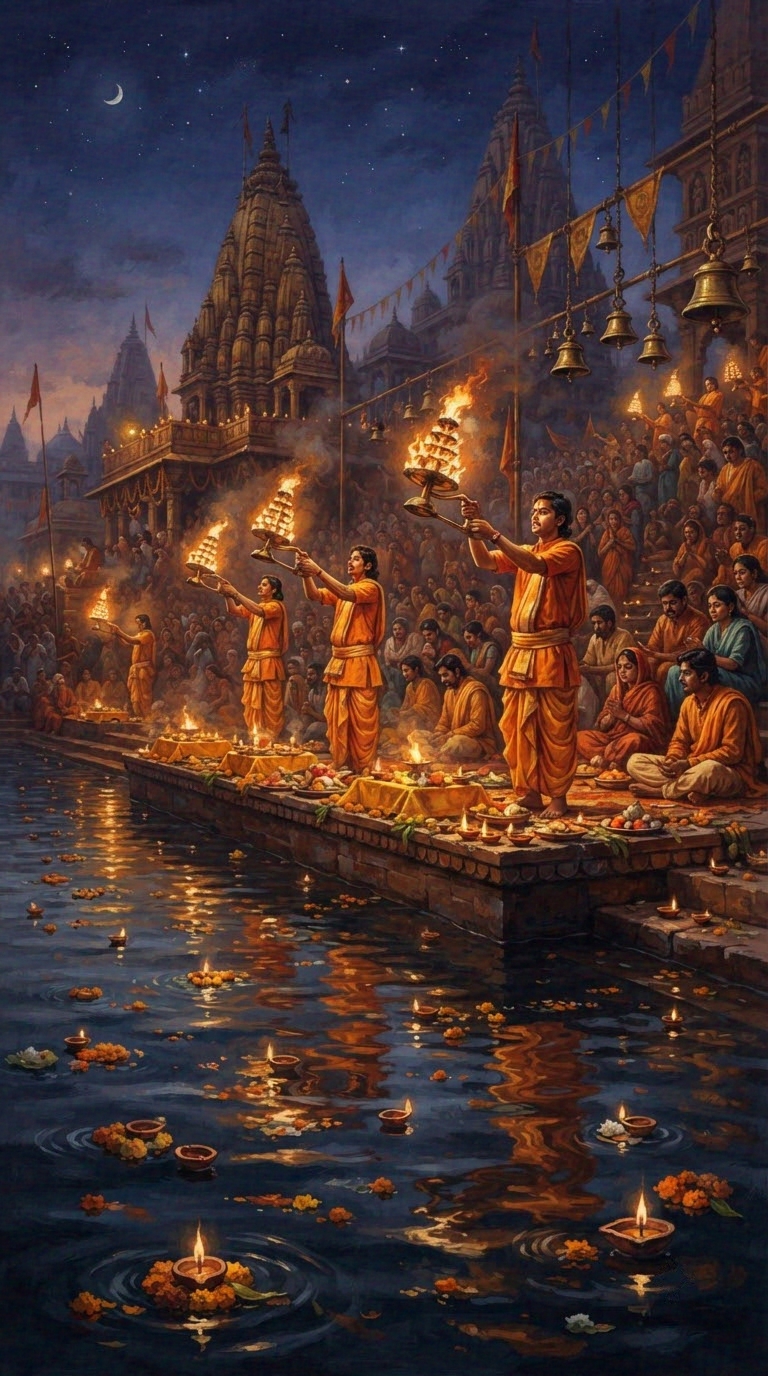
Explore in DevYatra
Frequently asked
When are the Simhastha Kumbh Amrit Snans?
Are these Simhastha Kumbh dates confirmed?
Can I take part in the Simhastha Kumbh from home?
The dates, the panchang, the guides
Get the festival dates for your city, the panchang, and source-checked temple guides — free in DevYatra.