Featured event · Kerala
Onam · Kerala Welcomes the King Home
For ten days the pookkalam grows a ring at a time, until on Thiruvonam all of Kerala — every home, every community — sits down to one feast on a banana leaf, to welcome home the king the land still loves.
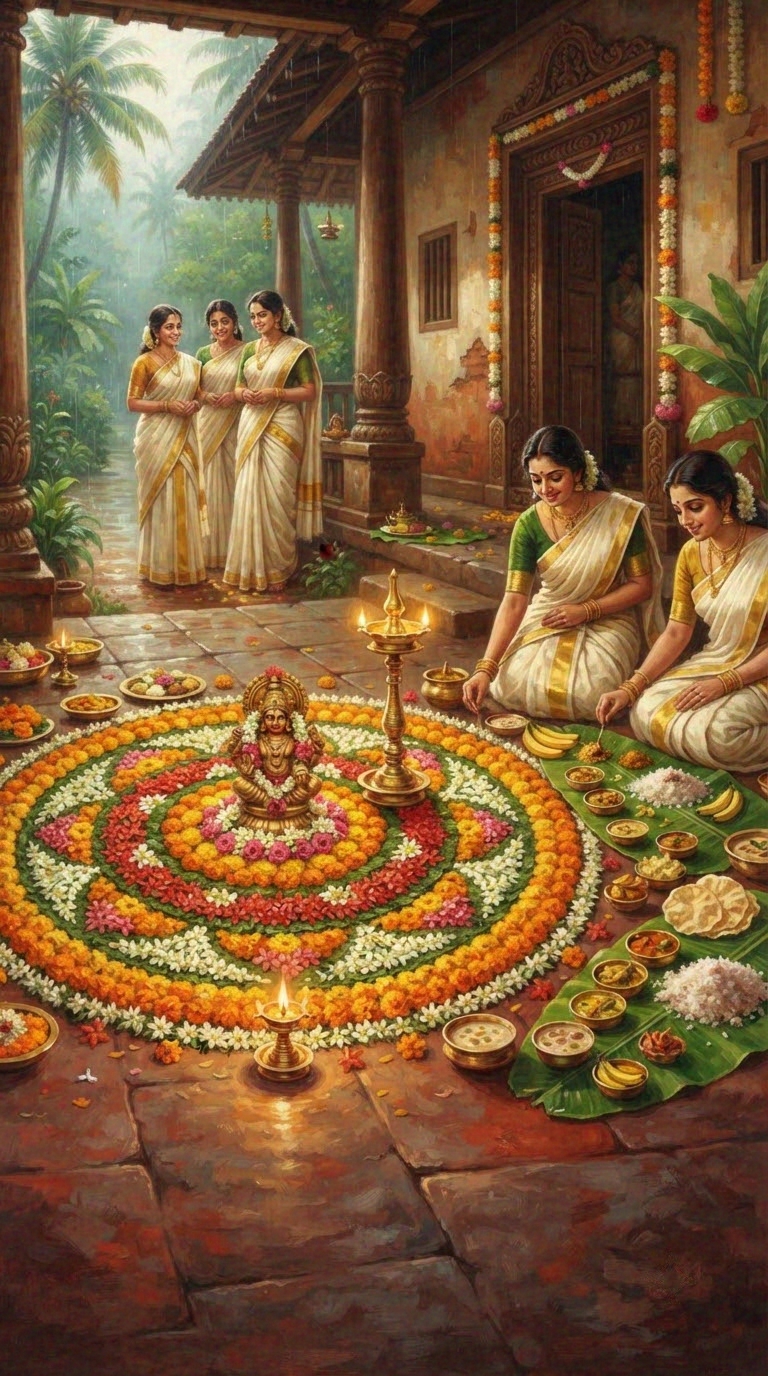
Kerala lays a carpet of flowers
When the long rains thin and the paddy stands heavy in the fields, the Malayalam year begins again: Chingam, the first month — the month of harvest, and of homecoming. Onam is Kerala's great festival of both. For ten days the land makes itself beautiful the way a family does before a beloved guest arrives, because a guest is arriving: the tradition of Kerala remembers that on Thiruvonam its most beloved king returns to see his people. Locally it is said that Chingam's plenty lands all the sweeter because the month before it, Karkidakam, is the lean month of rain and scarcity — the festival arrives exactly as the granaries turn full.
The ten days are counted not by dates but by stars. From Atham to Thiruvonam, each day bears the name of the nakshatra that rules it, and each day the pookkalam — the flower-carpet laid at the threshold — grows by one ring. On Atham morning a small circle is laid; the next day a second ring goes around it, and the next a third, so that the carpet keeps the festival's own calendar: you can read in flowers how near the king is. By Thiruvonam the pookkalam stands at full bloom, and the house it fronts is ready.
Onam is anchored to the sky differently from most festivals this app keeps: not to a tithi but to a star. Thiruvonam is the day the Shravana nakshatra prevails in the month of Chingam. In the 2026 cycle, Atham falls on Sunday, August 16 and Thiruvonam on Wednesday, August 26, with Uthradom — First Onam, the king's arriving-day — on August 25. This year the star-count stretches across eleven civil days, because one star, Vishakham, holds two of them; the pookkalam simply keeps a ring for each. These dates are read from the Malayalam calendar and confirmed by hand against Kerala's panchangam — they carry a reviewer's confirmation, not a computed clock.
The festival opens quietly at every doorstep where the first ring of flowers is laid. And it belongs to everyone: Onam is Kerala's festival before it is any one community's — Hindu, Christian, and Muslim households alike lay the pookkalam and sit down to the sadya, because the king who is coming was king of the whole land.
Dates & calendar
| Observance | Date | Weekday | Tithi / reference | Status |
|---|---|---|---|---|
| Atham — the first ring of the pookkalam | Sunday | Atham (Hasta) nakshatra prevailing in Chingam | Provisional | |
| Uthradom — First Onam, the king's arriving-day | Tuesday | Uthradam (Uttarashada) nakshatra prevailing in Chingam | Provisional | |
| Thiruvonam — the main day | Wednesday | Thiruvonam (Shravana) nakshatra prevailing in Chingam | Provisional |
These dates are shown as provisional until each is individually verified — shown, not asserted.
The three strides, and the king who comes home
Kerala keeps its history in a song. Maveli nadu vaneedum kalam, manusharellarum onnupole — "when Maveli ruled the land, all people were as one." The old Onam verses go on: no deceit then, no false measures and no false words, no theft, no sorrow to be found anywhere. The tradition of Kerala remembers Mahabali — Maveli, as the land calls him with affection — not as a figure of myth but as a memory: the asura emperor under whom the country knew its golden age.
He was the grandson of Prahlada, the child whom no fire or fury could part from Vishnu, and the devotion ran true in the line: Mahabali was righteous, truthful, and boundlessly generous — an emperor whose word, once given, was never taken back. His rule grew so complete, and so beloved, that it unsettled the order of the worlds; the devas looked at an asura seated where they had been, and could not rest.
The Bhagavata recounts what came next. Vishnu took birth as Vamana, a dwarf brahmachari, radiant and small, and came walking to the great yajna Mahabali was performing. The emperor received the boy with honor and offered him anything he asked. Vamana asked for three paces of land, measured by his own small feet. Shukracharya, guru of the asuras, saw who stood before them and warned the king to refuse. Mahabali would not: a promise made at his yajna would be kept, whatever it cost and whoever had come to collect. That is the hinge of the whole story, and Kerala has never let go of it — the moment an asura emperor kept his word to God, knowing.
Then the dwarf grew. As Trivikrama he measured the earth with one stride and the heavens with the second, and there was nowhere left in the three worlds for the third. Mahabali did not look for an escape. He bowed, and offered his own head. Hear this the way Kerala tells it: the foot that yogis seek across lifetimes of meditation came down, unasked-for and unearned, onto the head of the one king who had held nothing back — not a conquest completed, but a blessing given its resting place. The Bhagavata itself honors him so: Vishnu grants him the realm of Sutala with the Lord himself standing guard at his gate, and counts Bali among the twelve great knowers of dharma, beside his grandfather Prahlada. Nothing in this katha is an enemy subdued. It is a surrender so complete that God bent down to honor it.
And the tradition of Kerala remembers one grace more — the one the whole festival stands on. Mahabali asked to see his people once each year, and it was granted. On Thiruvonam he comes. Every pookkalam is laid for his passing eyes, and every feast is set so that when the king looks at his land he finds it as he left it: prosperous, honest, glad, and together.
The ritual heart of all this beats at Thrikkakara, near Kochi — one of the rare temples where the Lord is worshipped as Vamana himself. Locally it is said the very name is thiru-kaal-kara, the land of the sacred foot, where the stride came down. The temple keeps the full ten days from Atham to Thiruvonam. And locally it is told that when the land's people could no longer travel to Thrikkakara for the festival, it was decreed that every home should become its own Thrikkakara — which is why the figure at the heart of every household Onam bears the temple's own name.
From the first ring to the full leaf
The first thing Onam asks of a household is flowers, gathered fresh each morning. Through the ten days the pookkalam is the day's opening act: blossoms collected at dawn and laid into the carpet's newest ring before the day begins. The design is yours; the discipline is the ring. One more circle each morning, so that the carpet and the calendar arrive at fullness together.
At the center of the finished pookkalam the household raises Onathappan — small pyramids of raw clay, shaped by hand. His fuller name says everything the story just told: Thrikkakarayappan, the Lord of Thrikkakara — Vamana himself, seated in the middle of the flowers laid for Mahabali. The king and the God who blessed him are received together, at the same threshold; Kerala has never seen a reason to separate them.
Uthradom, the eve, is First Onam — the day the king is held to set out for his land. It is the festival's great day of readiness: the markets full into the night, the last provisions carried home, the kitchen already at work. By nightfall the house is provisioned like a house expecting royalty, because it is.
Then Thiruvonam, and the Onasadya. On a banana leaf, course upon course is laid. But the sadya's meaning is not in its count of dishes. It is that everyone sits down together, on the same floor, to the same food on the same leaf — elder and child, host and guest, whoever has come. For one afternoon the song is enacted rather than sung: all people as one. That is what the returning king is meant to see.
Onakkodi comes with the day — new clothes for the festival — so that the king finds his people not only fed but renewed.
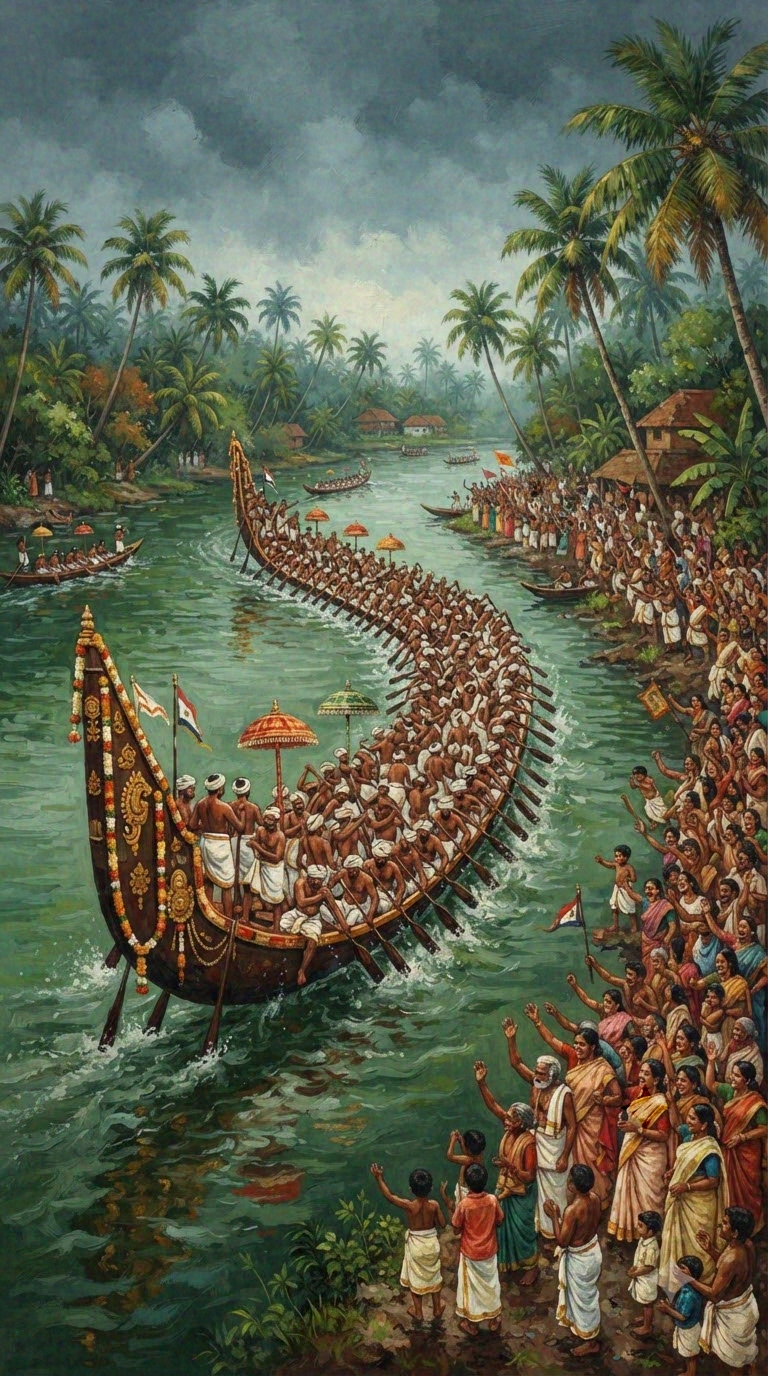
Around this ritual core, Kerala hangs the festival's cultural garland — of it, loved with it, and distinct from it. The vallamkali, when the long chundan vallams take to the backwaters, driven by the vanchipattu boat songs; Pulikali, when painted tigers dance through the streets; Kaikottikali, when women circle the pookkalam, clapping the old songs into rhythm. None of these is the worship; all of them are the joy.
And wherever Malayalis have gone, Onam has gone. A pookkalam is laid in whatever flowers the new country offers, and the sadya is set — often on the nearest weekend, so the whole family can sit to one leaf. The stars keep the day; the household keeps the king. He has never needed the geography — only the welcome.
Gallery
Explore in DevYatra
Frequently asked
When is Onam 2026?
Are these Onam dates confirmed?
Can I observe Onam away from home?
The dates, the panchang, the guides
Get the festival dates for your city, the panchang, and source-checked temple guides — free in DevYatra.