Featured event · India
Sharad Navratri · Nine Nights of the Devi
For nine autumn nights the Devi is honored in nine forms and a hundred ways — the kalash at home, the pandal drum, the golu steps, the garba circle — until the tenth day dawns as Vijayadashami: her victory, and every beginning's.
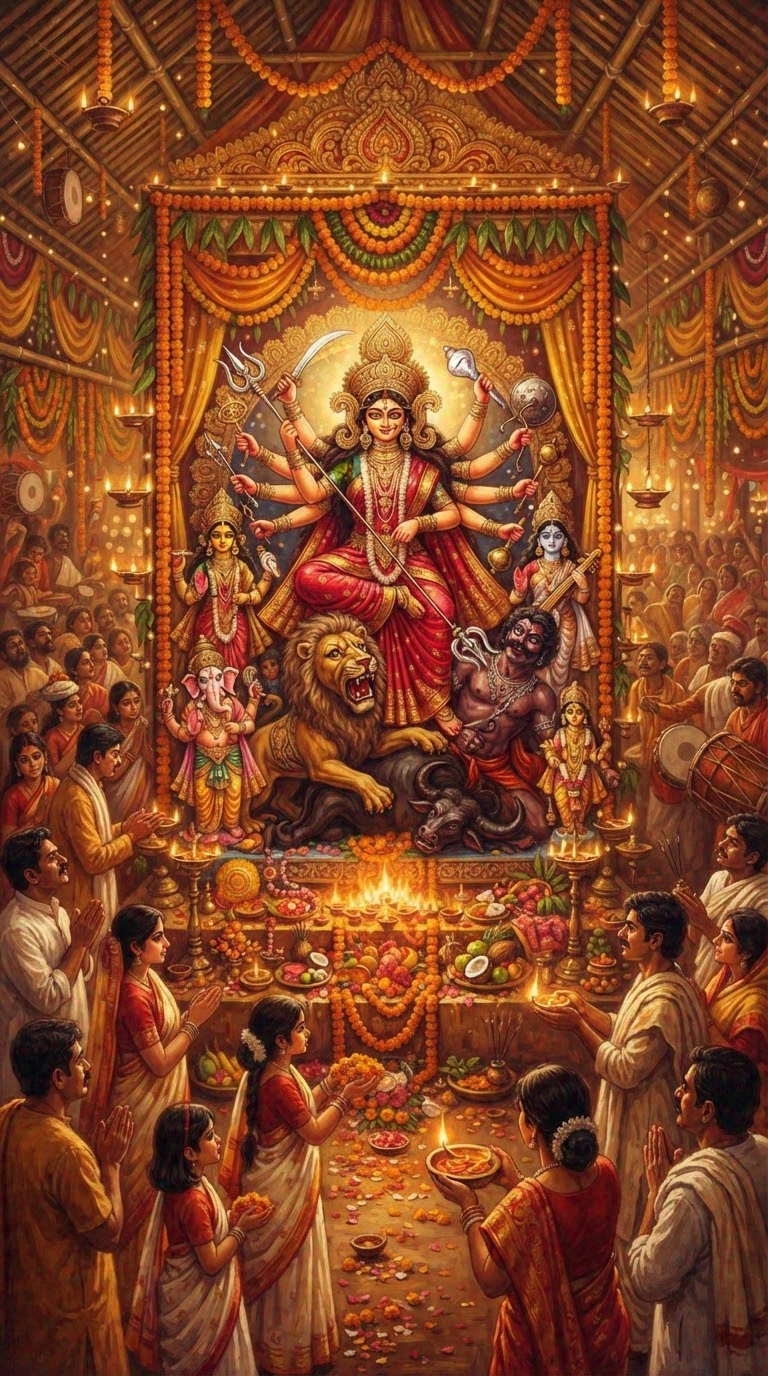
Nine nights, one Goddess
When the rains withdraw and the sky sharpens, the Devi's season begins. On Ashwina Shukla Pratipada a kalash is established in homes across the world — Ghatasthapana — and for nine nights the Goddess is worshipped as nine forms of one power. Sharad Navratri is the great autumn Navratri, the one most of India simply calls Navratri; and the tenth morning it opens onto is Vijayadashami — the victory of the tenth — when her long battle ends in triumph.
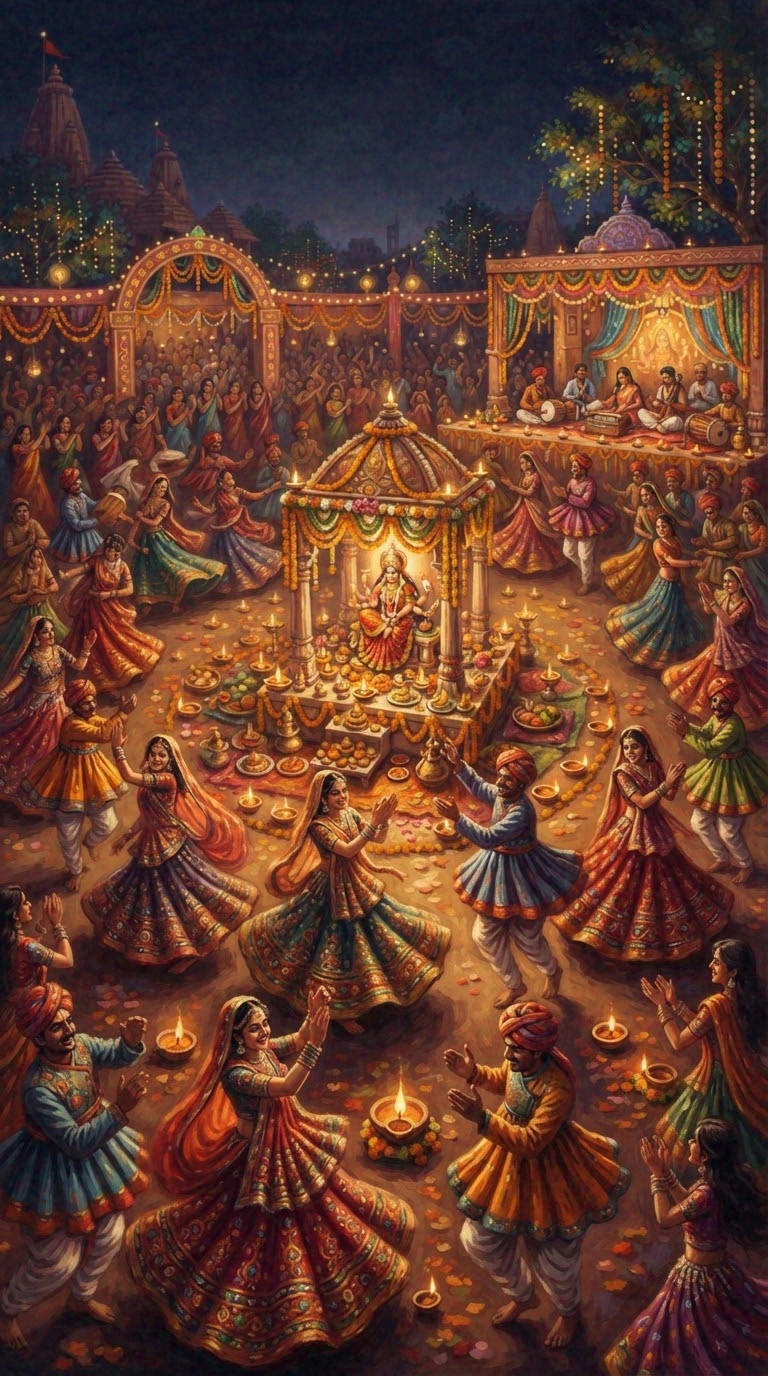
No other festival wears so many faces at once, and every face is the festival. In Bengal, Odisha, and Assam these nights are Durga Puja: Mahalaya at the fortnight's turn, when the Devi Paksha begins and, locally, whole cities wake before dawn to the chanted Mahishasura Mardini on the radio; Bodhon on Shashthi evening, the awakening of the Goddess in the pandal; then Saptami, Ashtami, Navami in a rising tide of drum and anjali, until Dashami's sindoor khela and the immersion. In Tamil Nadu, Karnataka, and Andhra the same nights are Golu — Bommai Kolu — the stepped display of dolls that turns the living room into a court of the gods, with neighbors visiting from house to house. In Gujarat they are danced: Garba around the lamp, and dandiya-raas late into the night. And across the North, the Ramlila plays Rama's story night by night until Ravana burns on Dussehra. None of these is the original and none is a variation. They are four rooms of one house, and the Devi is at home in all of them.
The date is not fixed by any authority; it is read from the sky. The app computes Ashwina Shukla Pratipada — and the Ghatasthapana muhurat for your own city — from its panchang engine. In the 2026 cycle the nine nights begin on October 11 and Vijayadashami falls on October 20. If you live outside India, the dates you see follow your own sunrise, not another continent's clock — the tithi travels with the sky, and so does the Goddess.
Dates & calendar
| Observance | Date | Weekday | Tithi / reference | Status |
|---|---|---|---|---|
| Ghatasthapana — Sharad Navratri begins | Sunday | Ashwina Shukla Pratipada | Provisional | |
| Durga Ashtami / Maha Ashtami | Monday | Ashwina Shukla Ashtami | Provisional | |
| Vijayadashami / Dussehra | Tuesday | Ashwina Shukla Dashami, aparahna | Provisional |
The headline date is checked against the New Delhi reference; the table lists the 2026 cross-check cycle, shown as provisional until each date is individually verified. DevYatra computes the observance for your own city.
The Devi made of every god's fire
The Devi Mahatmya recounts that Mahishasura, the buffalo-demon, had grown too strong for heaven. A boon shielded him from every god and every man; he drove Indra from his seat and the devas from their realms. And when the dispossessed gods stood before Vishnu and Shiva and told what had been done, a great radiance came forth from the face of each god — from Shiva, from Vishnu, from Brahma, from every deva a stream of tejas — and the streams flowed together into one blazing form: a woman, filling the directions with light. What no god could do alone, all of them together could only become. Then each gave her his own strength as a weapon — Shiva his trident, Vishnu his chakra, Indra his vajra, Vayu his bow, and from Himavan, lord of mountains, a lion for her mount.
The tradition holds that the battle raged for nine nights — these nine nights — and the Devi Mahatmya recounts its ending. Mahishasura would not hold one shape: cornered as a buffalo he became a lion, then a swordsman, then an elephant, then a buffalo again — and the Devi, having laughed and drunk from her cup, pinned him beneath her foot, and as the demon struggled half-out of the buffalo's own mouth to escape its dying, she beheaded him. That is the moment the murtis in every pandal hold: Mahishasura-mardini, the slayer of Mahisha, her lion at her side, victory arriving not gently but completely. The tenth day carries the name of what she did: vijaya, victory — Vijayadashami.
Through the nine nights she is honored as the Navadurga, nine forms for nine nights — Shailaputri, Brahmacharini, Chandraghanta, Kushmanda, Skandamata, Katyayani, Kalaratri, Mahagauri, Siddhidatri — the daughter of the mountain first, the giver of attainment last, as if the nights themselves climb from the foothills to the summit.
And there is a second victory laid on the same day. The tradition holds that Rama himself worshipped the Devi before he faced Ravana — an awakening out of season, for autumn is the night of the gods, and so Bengal calls it Akalbodhan, the untimely awakening; the Bodhon rite of every Durga Puja repeats it. As Bengal tells it, Rama vowed her one hundred and eight blue lotuses and, finding one short, offered one of his own eyes in its place — and the Devi stayed his hand and granted the victory. So the effigies that burn across the North on Dussehra and the sindoor on the Devi's face in Bengal are not two festivals sharing a date. They are one teaching told twice: that the Goddess is where victory comes from, and the tenth day belongs to her.
Keeping the nine nights
It begins with water and earth. On the first morning, in the muhurat the app reads for your own city, the kalash is established: a clay or metal pot filled with water, the sacred rivers invoked into it, mango leaves at its mouth and a coconut above, set on a bed of earth sown with barley. For nine days the Devi is worshipped in that kalash, and the barley quietly does what the festival is about: by Vijayadashami the khetri has risen green — locally its growth is read as the blessing on the household's year.
Many keep the nine days as a vrat. The common form is phalahar — fruits, milk, and the fast-flours, kuttu and singhara, with sabudana, and rock salt in place of common salt; grains and onion-garlic set aside; some families fast all nine days, others the first and the last. Each night belongs to one of the nine forms, and many recite the Durga Saptashati across the nights. The app reads the panchang for each day; let it name the night's form rather than a printed table — in some years a tithi doubles or drops, and the sky, not the poster, decides.
On Ashtami and Navami comes kanya pujan: young girls are received as the Devi herself — feet washed, tika given, fed before anyone else, most often puri, chana, and halwa — the festival's plainest teaching, that the Goddess worshipped nine nights in a kalash is honored on the ninth in a child at your own table. In the pandals of the East, Ashtami morning is the anjali — flowers offered with the whole neighborhood standing barefoot together — and at the turning of Ashtami into Navami falls the Sandhi puja, held in the tradition to be the most charged passage of the Puja, when one hundred and eight lamps are lit. On Dashami, married women take sindoor to the Devi's face and to each other — sindoor khela — before she is carried to the water. In the South, the golu stands on its odd-numbered steps through all nine nights; sundal is cooked and shared, Saraswati and the tools of one's work are honored as the nights close, and on Vijayadashami one doll is laid down to sleep and the golu is put away for the year; in Kerala the day is vidyarambham, when children write their first letters. In the West, the garba circles the lamp-lit pot night after night — locally it is said the garbo is the womb of the world, the lamp the life within it.
The tenth day is for beginnings. The tradition holds that the Pandavas, their exile ending, took their weapons back from the shami tree on Vijayadashami, and the shami is honored still; locally in Maharashtra and the Deccan, apta leaves are exchanged as gold, and the day is counted among the year's few whole-day auspicious muhurats. Ravana burns at Ramlila grounds as the evening comes. Whatever your family's stream — immersion, sindoor, a doll laid to sleep, a last garba — the ending is the same: the Devi departs having won, and what you begin on her tenth day begins well.
Gallery
Explore in DevYatra
Frequently asked
When is Sharad Navratri 2026?
Is Sharad Navratri on the same day everywhere?
Are the other dates listed here confirmed?
The dates, the panchang, the guides
Get the festival dates for your city, the panchang, and source-checked temple guides — free in DevYatra.