Featured event · Nashik–Trimbakeshwar
Simhastha Kumbh · Nashik–Trimbakeshwar · 2027
After twelve years, Guru enters Simha and the Kumbh returns to the Godavari. The flag rises at Ramkund in October 2026; the Amrit Snans follow in 2027 — and wherever you are, the river's morning reaches you.
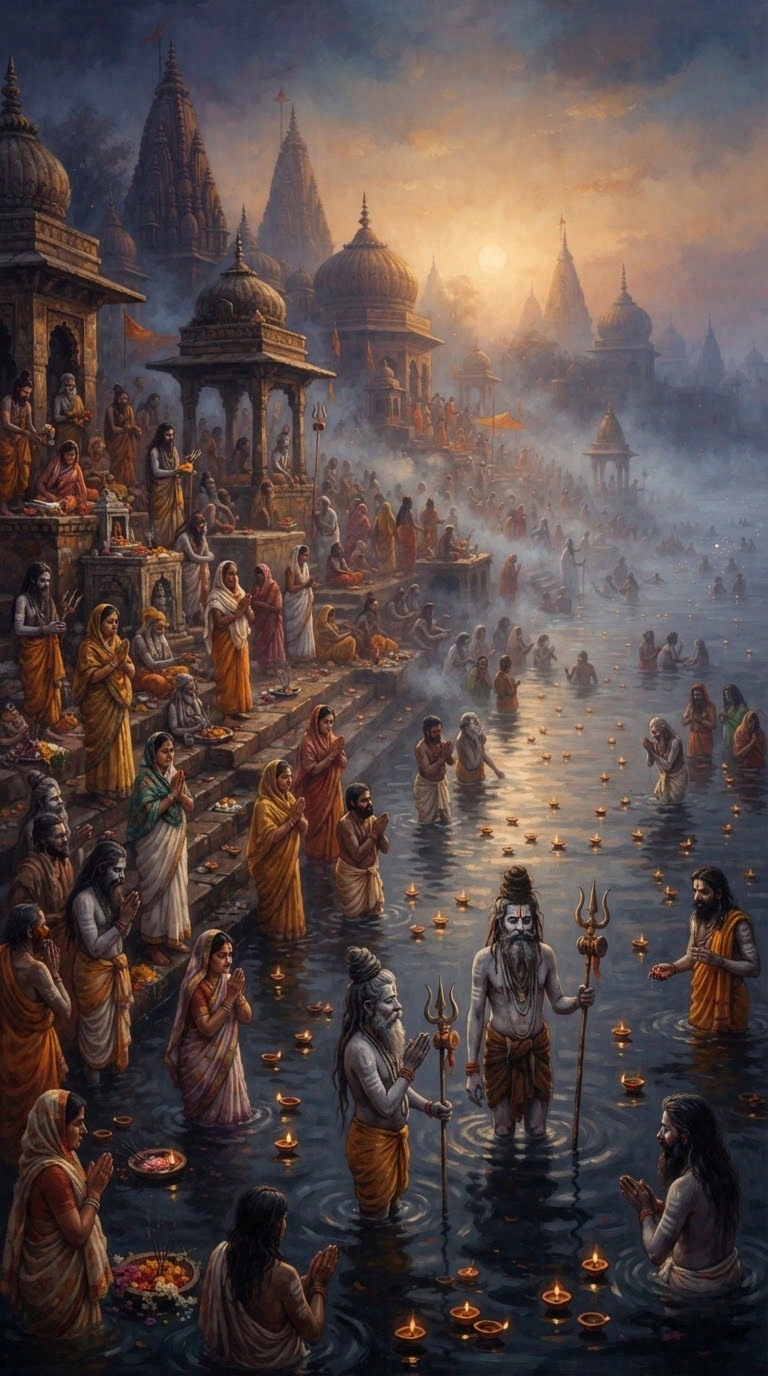
The Simhastha returns to the Godavari
Once in twelve years, Guru — Brihaspati, the slow, bright teacher among the grahas — enters Simha rashi, and that entry summons the Kumbh to the Godavari. This is why the gathering here carries its own name. Not simply a Kumbh Mela: the Simhastha — “seated in Simha.” Your panchang marks Guru’s unhurried walk through the rashis every day; this is the season that walk brings him home to the Lion, and brings the tirtha its appointment. The last Simhastha on this river was held in 2015. The next begins when the flag rises at Ramkund on Dhwajarohan day, and gathers to its full tide with the Amrit Snans of 2027.
Two waters hold the sanctity here, and both are one river. At Trimbakeshwar, beneath Brahmagiri hill where the Godavari is born, lies Kushavarta Kund, in the shadow of the Jyotirlinga. Downstream at Nashik, in the Panchavati of the Ramayana, lies Ramkund, where tradition holds that Rama himself bathed. The Simhastha belongs to both — which is why its name is spoken double: Nashik–Trimbakeshwar.
Four tirthas share the Kumbh among themselves — Prayagraj, Haridwar, Ujjain, Nashik — each keeping its own appointment with the heavens in turn. In 2027, the turn is the Godavari’s.
The dates on these pages are declared by the mela authorities and remain provisional until officially confirmed.
Dates & calendar
| Observance | Date | Weekday | Tithi / reference | Status |
|---|---|---|---|---|
| Dhwajarohan — the flag rises | Saturday | Declared muhurat (mela authority); tithi provisional | Provisional | |
| First Amrit Snan | Monday | Somvati Amavasya (Monday Amavasya; Ashadha Amavasya by the Amanta reckoning) | Provisional | |
| Second Amrit Snan | Tuesday | Shravana Amavasya (Amanta) | Provisional | |
| Third Amrit Snan — day one | Saturday | Bhadrapada Shukla Ekadashi | Provisional | |
| Third Amrit Snan — day two | Sunday | Bhadrapada Shukla Dwadashi — Vamana Jayanti | Provisional |
These dates are declared by the mela authority and remain provisional until officially confirmed — shown, not asserted.
When the river fills: the Snan Calendar
The Simhastha begins not with a bath but with a flag. On Dhwajarohan day the dhwaja rises, and from that hour the whole valley is under the vow. The mela then keeps its long season on the river — announced to run until July 2028 — but its heart beats three times, on the Amrit Snan days (the name the akharas themselves restored in 2025, for what was formerly called Shahi Snan).
Each day is holy for a reason the calendar only points to: the tithi. The first Amrit Snan falls on a Somvati Amavasya — an Amavasya that arrives on Somvar, Shiva’s own day, a meeting tradition counts doubly sacred. The second falls on Shravana Amavasya, the dark-moon close of the month dearest to Shiva. The third spans Bhadrapada Shukla Ekadashi and Dwadashi — and that Dwadashi is Vamana Jayanti, the avatara-day of Vishnu who measured the worlds in three strides, a day of particular weight for the Vaishnava akharas. Since the Peshwa era, the two great families of akharas have kept separate waters here: Shaiva sannyasis at Kushavarta in Trimbak, Vaishnava bairagis at Ramkund in Nashik — a distinction found at no other Kumbh. Which of the two September days belongs to which ghat awaits the authority’s word; this page will name the split when it is officially declared.
These dates are declared by the mela authority and are provisional until officially confirmed; if a date moves, this page will say so plainly.
On a snan day, the holiest window opens in Brahma muhurta, before the sun has touched the water. The akharas descend first, in an order of precedence kept across generations; the public enters after. To stand back while the standards pass down to the river is not waiting — it is the first act of your own snan. And wherever you are, the river’s morning reaches you: the tithi rises over your own horizon, and a sankalpa taken with her name is a snan the tradition itself honors.
The declared days:
- Sat 31 Oct 2026 — Dhwajarohan (flag-hoisting) — provisional
- Mon 2 Aug 2027 — First Amrit Snan — Somvati Amavasya — provisional
- Tue 31 Aug 2027 — Second Amrit Snan — Shravana Amavasya (Amanta) — provisional
- Sat 11 Sep 2027 — Third Amrit Snan, day one — Bhadrapada Shukla Ekadashi — provisional
- Sun 12 Sep 2027 — Third Amrit Snan, day two — Bhadrapada Shukla Dwadashi · Vamana Jayanti — provisional
Between these, the parva snan days — the Shravan Somvars, the purnimas — follow the panchang, and the app’s own engine will keep them for you.
The churning, the drops, and why the water remembers
The Bhagavata recounts that the devas and the asuras once churned the ocean of milk together, seeking the amrit — the nectar of deathlessness. Mount Mandara was their churning rod; Vasuki, king of serpents, consented to be the rope. When the mountain began to sink into the deep, Vishnu descended as Kurma, the great tortoise, and bore its whole turning weight upon his back — the Lord becoming the still foundation beneath the world’s labor.
And before the nectar, the poison. Out of the churning rose the Halahala, a darkness fierce enough to scorch the three worlds, and no one — deva or asura — could stand before it. It was Shiva who, out of compassion for every being, gathered it into his palm and drank — and held it in his throat, letting it travel no further. The poison stayed there, and stained his throat a deep blue: Neelakantha, the blue-throated one. Hold that name a moment, because here it is not a distant epithet. The Simhastha unfolds at a Jyotirlinga kshetra — the one who kept the world’s poison in his own throat is the very one enthroned above the river’s source at Trimbakeshwar.
The churning went on, and at last Dhanvantari rose from the waves, luminous, bearing in his hands the kumbha — the pot of amrit. It is from this pot that the Kumbha Mela takes its name.
The tradition cherished at the Kumbh holds that as the pot was carried from the churning, four drops of amrit fell upon the earth — at Prayagraj, at Haridwar, at Ujjain, and here, upon the Godavari at Nashik. And it holds that when the grahas return to their remembered places, the waters at those four tirthas become, for those days, what fell into them. The rivers remember.
At each tirtha the remembering has its own sign. Here, the sign is Guru in Simha: when Brihaspati enters the rashi of the Lion, tradition holds, the Godavari’s turn has come. That is the whole meaning of “Simhastha,” and it is why this gathering belongs to the same sky your daily panchang reads. This is not an event you attend; it is a rhythm you are already inside.
And why does the snan purify? Begin with the word the tradition chose. A tirtha is a ford — a shallow place in the river of existence where the far shore comes near enough to touch. This river is no ordinary water even on ordinary days: she is Gautami Ganga, the Ganga of the south, for the kshetra remembers how the sage Gautama, by long tapasya on Brahmagiri, drew the Ganga down to flow here as the Godavari. On an Amrit Snan day, three sanctities meet in one place: the kshetra, the sacred time the grahas have opened, and the assembly of sants and akharas gathered on the banks. Into that confluence the devotee steps — but the step itself is made of two things the water cannot supply: sankalpa, the intention spoken and meant, and shraddha, the trust that offers it.
The elders put it simply: the Godavari can carry away what you place in her — but only what you truly place. The outer bath and the inner bath are taken together, or neither is taken at all.
Gallery
Explore in DevYatra
Frequently asked
When are the Simhastha Kumbh Amrit Snans?
Are these Simhastha Kumbh dates confirmed?
Can I take part in the Simhastha Kumbh from home?
The dates, the panchang, the guides
Get the festival dates for your city, the panchang, and source-checked temple guides — free in DevYatra.