Featured event · India
Ganesh Chaturthi · Bappa Comes Home
For ten days the Lord of Beginnings is the guest of the house — from sthapana at madhyahna to the farewell at the water. Vighnaharta comes home, and the whole town walks him to the river.
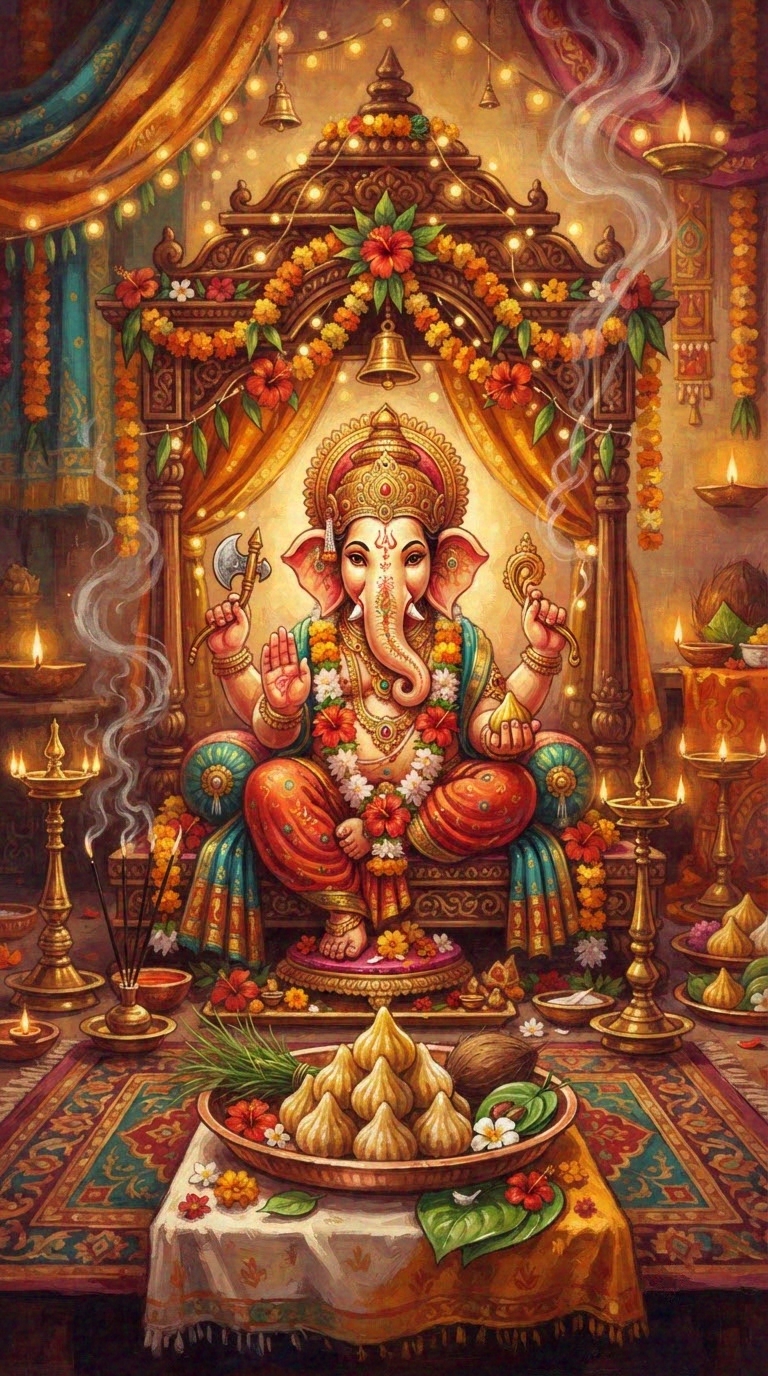
Bappa comes home
Bappa is coming home. Of all the festivals your panchang keeps, this is the one that arrives not at a temple gate or a riverbank but at your own door. On Bhadrapada Shukla Chaturthi a murti of Ganesha is carried into the house and seated at madhyahna — the midday hour in which tradition holds he was born — and through pranapratishtha, breath is invoked into the clay. From that moment there is no murti in the house. There is a guest.
He is Vighnaharta, the remover of obstacles, and adi-pujya, the first-worshipped: before any other deva is invoked, before any undertaking begins, his name goes first. Locally, to begin anything at all — a ledger, a journey, a wedding — is simply called making its Shri Ganesha. So for ten days, the one who must be honored before every beginning sits in the middle of your household's ordinary ones: the cooking, the homework, the comings and goings, all of it now happening around him.
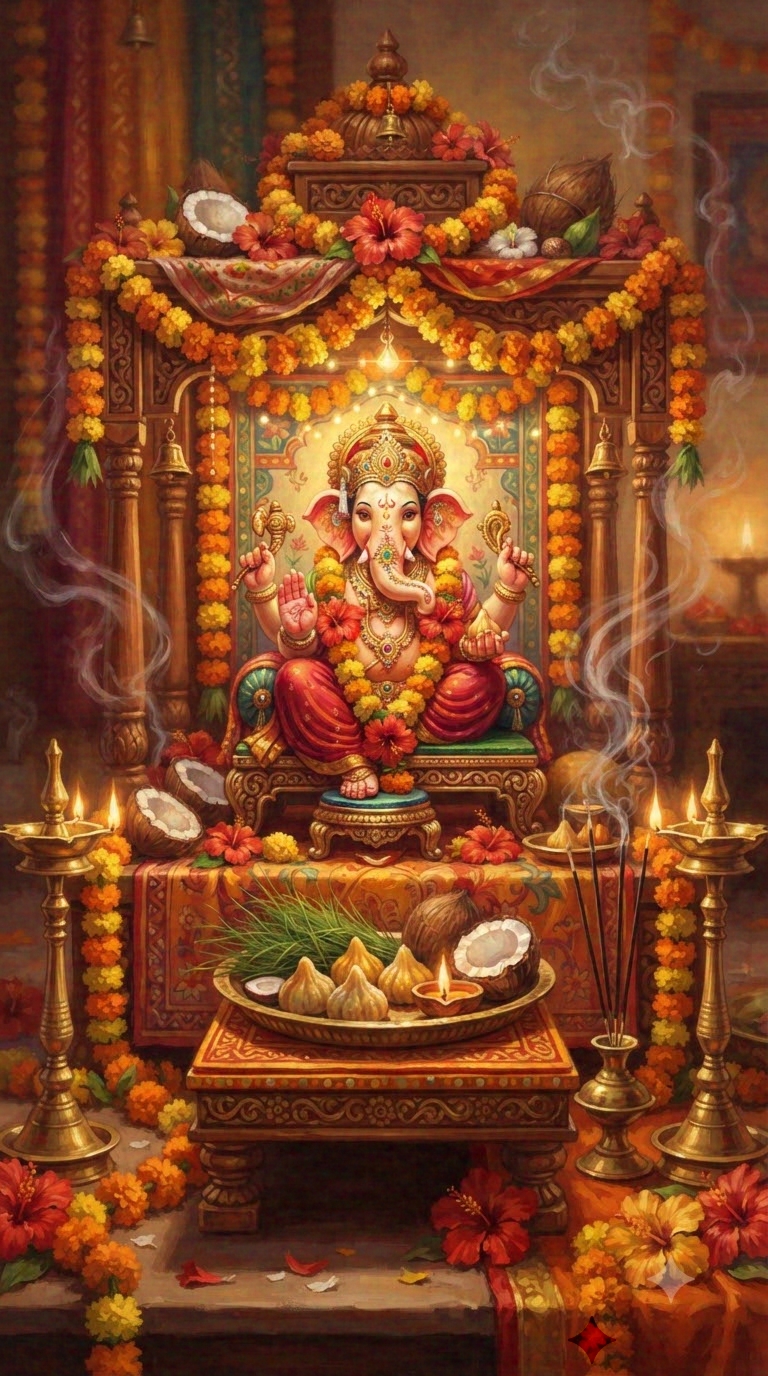
The house is made ready days ahead: a corner chosen, the seat raised, the makhar — the small decorated shrine-bower that frames his asana — built by whoever in the family builds such things. Then the days keep a simple rhythm. Aarti in the morning and again at lamp-lighting, the modak he is known to love, neighbors and cousins arriving for darshan of the household's guest. Then the farewell, each family by its own custom: some see Bappa to the water after did divas — a day and a half — others after three, five, or seven days; many keep him the whole ten. The grand farewell comes on Anant Chaturdashi, when every murti still remaining goes to the water together, and the streets themselves become the procession.
This date is not fixed by any authority; it is read from the sky. The app computes Bhadrapada Shukla Chaturthi — and the madhyahna sthapana muhurat for your own city — from its panchang engine, wherever in the world your mornings happen. In the 2026 cycle the sthapana falls on September 14 and Anant Chaturdashi on September 25. If you live outside India, the date you see follows your own sunrise, not another continent's clock — the tithi travels with the sky, and so does Bappa.
The household festival is also, in Maharashtra, a public one: the sarvajanik Ganeshotsav. The first public installation is credited to Bhausaheb Laxman Javale — Bhau Rangari — at his wada in Pune in 1892; from 1893, Lokmanya Tilak took the young practice up in Kesari and carried it into a festival of the whole people. What began at one doorway is now ten days in which entire cities keep the same guest.
Dates & calendar
| Observance | Date | Weekday | Tithi / reference | Status |
|---|---|---|---|---|
| Ganesha Sthapana — Ganesh Chaturthi | Monday | Bhadrapada Shukla Chaturthi | Provisional | |
| Anant Chaturdashi — grand visarjan | Friday | Bhadrapada Shukla Chaturdashi | Provisional |
The headline date is checked against the New Delhi reference; the table lists the 2026 cross-check cycle, shown as provisional until each date is individually verified. DevYatra computes the observance for your own city.
The boy at the door, and the moon that laughed
The Shiva Purana recounts that Parvati, before her bath, took the fragrant paste from her own limbs and shaped it into a boy — beautiful, strong, entirely hers — and breathed life into him, and set him at her door with one instruction: let no one enter. When Shiva returned, the boy did not know him, and kept his mother's word against the Lord of the universe himself. The ganas could not move him; the devas could not move him. In the battle that followed, Shiva severed the boy's head — and Parvati's grief shook the three worlds until the devas were sent north for the head of the first being they found, and returned bearing an elephant's. Set upon the boy's shoulders, it took life. Shiva named him Ganesha, lord of his own ganas, and gave the wound an unmatched honor: that no worship of any deva would bear fruit unless Ganesha was worshipped first. The tellings of how the elephant head came to him vary across the Puranas and the regions; what no telling varies on is what came of it. The boy who was refused at one door is now the first name spoken at every door.
And then there is the moon. The tradition holds that on the night of his birth-tithi, Ganesha — full of modakas, riding home on his mouse — was startled; the mouse stumbled, Bappa fell, and his belly spilled its sweets. He gathered them back, and bound his belly with a serpent for a belt. Chandra, the moon, watching from the sky, laughed. For that laughter came the curse: whoever looks upon the moon on Bhadrapada Shukla Chaturthi will suffer mithya dosha — false blame, an accusation one has not earned. This is why, on this one night of the year, devotees keep their eyes from the sky.
The tradition supplies the remedy in a story. The Bhagavata recounts how Krishna himself was falsely accused — of doing away with Prasena and stealing the Syamantaka jewel — and how he tracked the jewel from the lion's cave to Jambavan's, fought, reconciled, and returned it, clearing his name before the assembly. It is told that the false blame had touched even him because he had glimpsed the moon on this tithi; and so hearing the Syamantaka katha on Ganesh Chaturthi is held to dissolve the dosha for anyone whose eyes have strayed. The festival keeps even its warnings gently: for every prohibition, a katha that undoes it.
And the modak — rice flour steamed around a heart of jaggery and coconut, the sweet his hand always holds. The offering is kept at twenty-one, as are the blades of durva grass laid at his feet. Sweetness on the outside is easy; the modak carries its sweetness inside, where only the one who receives it knows.
This, finally, is who the household receives. Vighnaharta is not a clearer of roads only; he is the one the tradition trusts with beginnings themselves — which is why he is invoked before the beginning, not after the obstacle. A murti of him at the threshold of your ten days is the same theology at household scale: put the remover of obstacles first, and then begin everything else.
Keeping the ten days
It begins with the walk home. The murti — shadu maati, the soft unbaked river clay, if your family can find it — is carried to the house with ceremony. A raised seat, a clean cloth, the lamp lit: this is sthapana. Then pranapratishtha — the invocation by which breath enters the clay and the murti becomes the deity, a guest received rather than an object installed. When you are ready, the guided Ganesha puja in this app walks you through it the way a family elder would: each upachara in its order, each mantra in its place, from the first invocation to the offered modak.
Each morning of his stay, fresh durva at his feet — the tender three-bladed grass he prefers to any splendor — and each day closes with aarti. In lakhs of homes it is the same song: Sukhakarta Dukhaharta — "maker of joy, remover of sorrow" — composed, tradition holds, by Samarth Ramdas, sung to clapping and the thali's ring, recorded for this app by a human voice, as every aarti here is. Ten days of singing the same words to the same guest does something no single hearing can: by visarjan day, the household knows the song the way it knows its own names.
The farewell is a puja of its own. An uttarpuja before departure; the murti lifted from its asana at last. And then the cry that carries every procession to the water: "Ganpati Bappa Morya, pudhchya varshi laukar ya" — Ganpati Bappa Morya, come again soon, next year. It is a farewell that refuses to be one; it books the return even as it lets go. Locally it is said that "Morya" carries the name of Morya Gosavi, the great Ganesha-bhakta of Chinchwad, so that the shout binds the Lord and his devotee together in a single breath.
Visarjan is not disposal; it is returning the Lord to the element he was shaped from. This is why the tradition is turning back to shadu clay and to eco-visarjan — not as a regulation but as devotion: the river who receives Bappa is herself a goddess, and what we place in her hands should dissolve in her hands. A murti immersed in a bucket or tank at home is the same farewell, honored by the same custom, and kinder to the water. The clay softens, the form returns to formlessness, and the house is quieter that evening than it has been in ten days — which is how you know the guest was real.
Wherever you live, the tithi rises over your own horizon: the app reads the sthapana muhurat for your own city, and the farewell for your own river, tank, or bucket of clean water.
Gallery
Explore in DevYatra
Frequently asked
When is Ganesh Chaturthi 2026?
Is Ganesh Chaturthi on the same day everywhere?
Are the other dates listed here confirmed?
The dates, the panchang, the guides
Get the festival dates for your city, the panchang, and source-checked temple guides — free in DevYatra.