Featured event · India
Diwali · Deepavali · The Festival of Lights
On the darkest night of Kartik, every threshold answers with lamps. Five days — Dhanteras to Bhai Dooj — of light welcomed home, Lakshmi invited in, and the lamp within remembered. Wherever you live, the diya is lit there too.
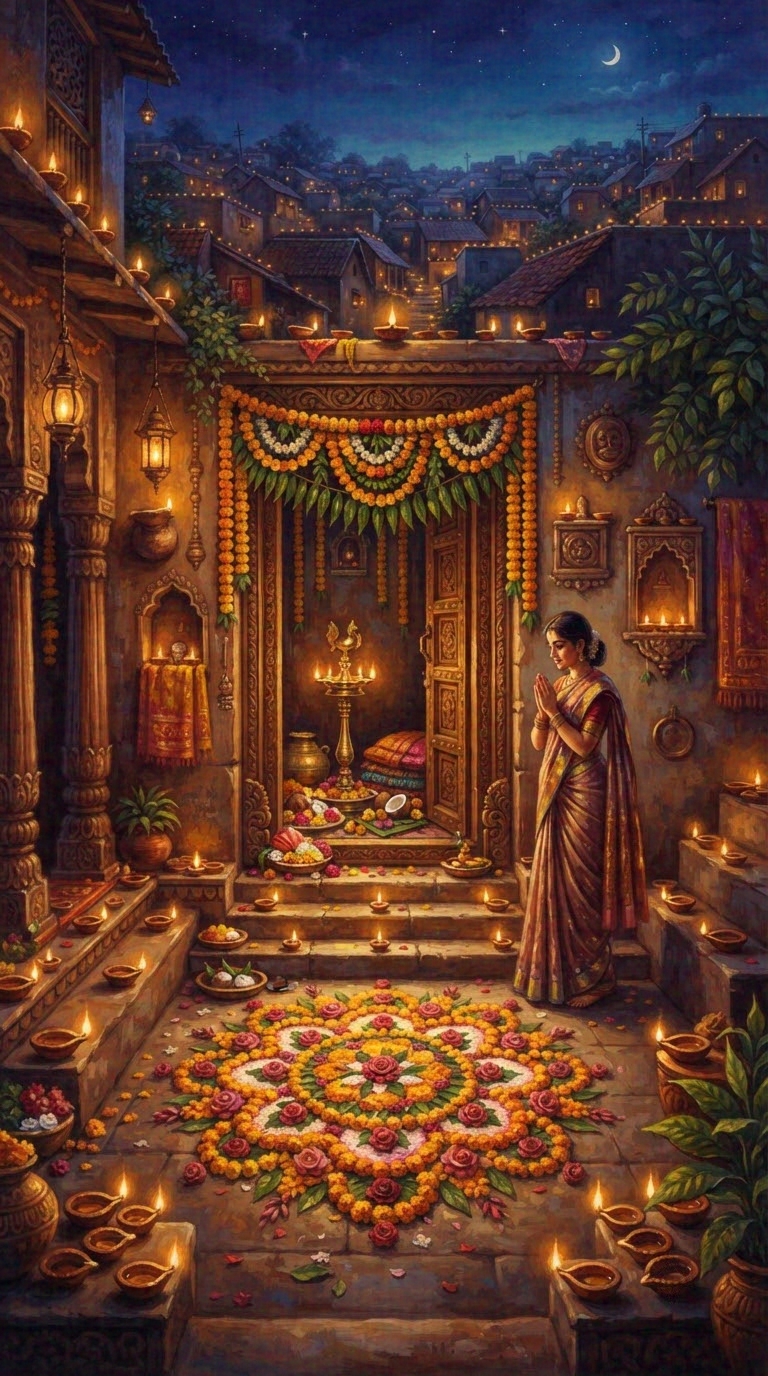
The night the lamps answer the dark
Once a year the calendar arrives at the new moon of Kartik — Amavasya, the darkest night of the darkening half of the year — and the tradition's answer to it is not to wait for the moon. The answer is Deepavali: an avali of deepas, a row of lamps, set out on every sill and threshold until the house itself does what the sky will not. That inversion is the whole festival. The darkest night is met with the most light.
Diwali is not one day but five, climbing toward that night and descending gently from it. Dhanteras opens the festival with the first lamps and the remembrance of Dhanvantari, the physician of the gods. Naraka Chaturdashi brings the dawn bath and the memory of a tyrant's fall. Then the main night — Lakshmi Puja on Kartik Amavasya — when the home is at its cleanest and brightest and the goddess of auspiciousness is welcomed in. Govardhan Puja follows, with its mountain of offered food, and Bhai Dooj closes the festival not with a rite to the gods but with a bond between a sister and a brother.
One thing should be said plainly, because it is a strength and not a confusion: different regions and communities keep different central stories on this night. In the north, the lamps are for Rama's homecoming to Ayodhya. In the south, the festival's heart is the dawn of Naraka's fall, the day before. In Bengal and Odisha, the same Amavasya belongs to the Mother, worshipped as Kali at the depth of night. And everywhere, the night is Lakshmi's. These are not competing claims to be settled. The night is large enough; each tradition remembers its own deliverance, and the lamp is the common tongue.
There is no congregation to travel to and no river to reach. The temple, tonight, is your own threshold. Wherever this finds you — a courtyard in Indore or a windowsill in New Jersey — the tithi rises over your own horizon, and the app keeps your local dates from the panchang itself.
Dates & calendar
| Observance | Date | Weekday | Tithi / reference | Status |
|---|---|---|---|---|
| Dhanteras — Dhanvantari Jayanti; the first lamps | Friday | Krishna Trayodashi at pradosh (purnimanta Kartik · amanta Ashwina) | Provisional | |
| Naraka Chaturdashi — the abhyanga snan at dawn | Sunday | Krishna Chaturdashi at arunodaya | Provisional | |
| Lakshmi Puja · Diwali — the main night (Kali Puja in Bengal) | Sunday | Kartik Amavasya at pradosh (amanta Ashwina Amavasya) | Provisional | |
| Govardhan Puja · Annakut · Bali Pratipada | Tuesday | Kartik Shukla Pratipada at sunrise (udaya) | Provisional | |
| Bhai Dooj · Bhau Beej · Yama Dwitiya — the festival closes | Wednesday | Kartik Shukla Dwitiya at aparahna | Provisional |
The headline date is checked against the New Delhi reference; the table lists the 2026 cross-check cycle, shown as provisional until each date is individually verified. DevYatra computes the observance for your own city.
One night, many homecomings
The lamps of Ayodhya. The Ramayana recounts fourteen years of vanavasa — the exile walked through forests, the abduction of Sita, the war at Lanka, and at last the vow completed and the way home open. The tradition of Ayodhya remembers what happened next: that Rama, Sita, and Lakshmana returned on the dark of the moon, and the city — which had counted every one of those fourteen years — set out rows of lamps so that the night itself could not delay the homecoming. This is the Diwali of the north: the lamp in the window as the shape of waiting rewarded, of a kingdom keeping faith. When you set a diya on your sill, that is the oldest thing it says — someone here kept the light on for your return.
The goddess who rose from the ocean. The Bhagavata recounts that when the devas and asuras churned the ocean of milk, among the treasures that rose from the churning came Shri herself — Lakshmi, seated on a lotus, radiant, and free. No one won her; she surveyed the assembly of gods and chose, and her garland fell on Vishnu. The tradition of Lakshmi Puja holds that on Kartik Amavasya she walks the earth, and enters homes that are clean, lit, and glad. Understand what is being welcomed: Lakshmi is not money. She is auspiciousness — fullness, order, grace, the well-being of a household at peace. She is invited, never demanded; the cleaning and the lamps are not payment but hospitality.
The tyrant's fall at dawn. The Bhagavata recounts, in its tenth book, the fall of Narakasura, the tyrant of Pragjyotisha — Krishna riding to that battle on Garuda with Satyabhama beside him, the fortress broken, the thousands of captive princesses freed and given honor. And the tradition holds that Naraka, dying, asked one grace: that the day of his fall be kept not with mourning but with lamps. This is Naraka Chaturdashi, the day before the main night — and across the south, this dawn is Deepavali: the oil bath before sunrise, new clothes, the first lamps while the stars are still out. Evil ended at dawn; the festival there begins with the sun.
The Mother at midnight. In Bengal, Odisha, and Assam, the same Amavasya is kept as Kali Puja — Shyama Puja — and the night carries its own name there: Dipanwita, the lamp-lit. The Mother is worshipped at nishita, the depth of the night, when the dark is total — fierce to what afflicts her children, endlessly tender to the children themselves. This is not Bengal keeping a different festival from Diwali; it is the same night showing another of its faces. Where the rest of the country sets lamps against the darkness, Bengal looks into the darkness and finds the Mother there — and sets lamps for her gladly.
Four streams, one night. No scripture ranks them, and this page will not either. What they share is exact: in every telling, something long endured — exile, captivity, darkness itself — ends, and the ending is marked with light.
The ladder of five days
The festival climbs day by day, and each rung has its own katha, its own rite, and in most regions its own name.
Dhanteras — Dhantrayodashi. On Krishna Trayodashi, the tradition remembers Dhanvantari rising from the churned ocean bearing the kumbha of amrit — the physician of the gods arriving with healing in his hands, before wealth was ever spoken of. The household honors dhana as grace rather than gain: a new metal vessel or coin is welcomed home as a sign of Lakshmi's coming, and the first diyas of the festival are lit. Many households also keep the Yama-deepam this evening — a single lamp set outside facing south, for the Lord of Death, that untimely death may pass the house by.
Naraka Chaturdashi — Chhoti Diwali · Kali Chaudas · Roop Chaudas. The day of Naraka's fall. Its rite is the abhyanga snan: oil and ubtan worked into the skin, and the bath taken before sunrise, in the arunodaya dark — the tradition holds that the sanctity of the Ganga enters the bathing water at that hour. In Maharashtra the bitter karit fruit is crushed underfoot before the bath, Naraka's fall enacted at your own doorstep. In the south, this is the principal day of Deepavali itself.
Lakshmi Puja — Diwali, the main night. Kartik Amavasya, at pradosh, as dusk becomes dark. The home stands at its cleanest and brightest of the year; Ganesha is worshipped first, as always, and Lakshmi beside him; trading families lay the new year's ledgers before her, the Chopda Pujan, so that livelihood itself is consecrated before it is used. In Bengal, this is the night of Kali Puja.
Govardhan Puja — Annakut · Bali Pratipada · Padwa. On Kartik Shukla Pratipada the Bhagavata's telling is of Krishna lifting Govardhan hill on one hand, sheltering the cowherds of Vraja from Indra's seven days of rain — and the rite answers it with Annakut, a mountain of food raised before the Lord and then shared out. In the west the day is Bali Pratipada, the one day King Bali walks among his people again; in Gujarat it opens the new year; in Maharashtra it is Diwali Padwa, kept between wife and husband.
Bhai Dooj — Bhau Beej · Bhai Phonta · Yama Dwitiya. The tradition remembers that on this Dwitiya, Yama himself came to dine at the home of his sister Yamuna, and gave his word that a brother who receives his sister's tilak on this day is guarded. Sisters mark their brothers' brows; the festival that began with a lamp for the Lord of Death ends with death's own lord honoring a sister's love. The five days close where the tradition means them to: not in the sky, but between people.
A note your panchang already knows: the ladder follows tithis, not civil dates. In some years the rungs crowd or stretch — in 2026 the snan-dawn and the Lakshmi-night share a single Sunday, and the ladder rests a day before Annakut. The app reads the panchang for your own city, so the dates on this page are always the tithi's, not the printed calendar's.
Why the lamp
Of all the things the tradition might have chosen to carry this night, it chose the smallest: a clay diya, a cotton wick, a little oil, a flame that a breath could end. Nothing about it is grand. Everything about it is deliberate.
The Upanishad's prayer is the lamp's own sentence: tamaso ma jyotir gamaya — from darkness, lead me to light. In the tradition's understanding, the darkness in that line was never the sky's. It is ignorance — of what we are, of what matters, of one another — and the light that answers it is jnana, knowing. The lamp-verse the tradition recites over an evening diya says it without argument: the lamp's light is itself a form of the highest, and what it removes is not night but the harm we do unseeing.
So the festival's timing is not an accident to be explained but the teaching itself. Diwali does not fall on the full moon, when light is given freely from above. It falls on Amavasya, when nothing is given, and every lamp that burns is one somebody chose to light, fill, and tend. On the night with no moon, the household becomes the moon. Light, this night says, is not found. It is kept.
And it is kept the way a flame is passed: one diya lights the next and loses nothing. That is why the lamps are rows and not a single blaze — each one lit from another, the way the festival itself has come down to you, hand to hand, from everyone who kept it before you.
The elders extend the lamp inward without ever making a lecture of it. The house is cleaned, and the heart with it; the threshold is made beautiful, and so is the greeting given across it; Lakshmi is welcomed, and everything unworthy of her company — the year's grudges, the swept corners of oneself — is carried out with the dust. That is the inner Diwali, and it needs no sermon: anyone who has stood in a doorway of lamps knows the room it makes is not only in the house.
Keeping Diwali at home
Begin before the day begins. The cleaning of the house in the days before Diwali is not a chore ahead of the rite — it is the first rite. Every cupboard turned out and every corner reached is part of the welcome; the tradition holds that Lakshmi enters where the threshold is clean and the lamp is lit.
On the morning of the main day, the threshold is dressed: rangoli at the door — the house declaring whom it is expecting.
In the evening, at pradosh — as dusk becomes dark — bathe and dress freshly, and settle the household at the altar. Ganesha is honored first, as he is before every undertaking, and Lakshmi beside him. Take the sankalpa: your name, your place, the tithi, and your intention, said plainly. Say it in Sanskrit if you have it; say it in your own tongue if you do not — a heartfelt vernacular sankalpa is fully valid.
Offer what a household offers: flowers, akshata, kumkum, a sweet made or bought with care — and the aarti sung together, with the household's own voices over any recording.
Then the lamps, and this order is its own small teaching: the first diya is lit from the puja flame, and every other lamp in the house is lit from that one — the doorway, the windowsills, beside the tulsi, and into the corners no one visits, because those are the corners the festival is for.
Keep the night with light, not noise. The diya asks nothing of the street; let the celebration be one that elders, infants, birds, and animals can also keep — the night belongs to the lamp, and a quiet doorway of flames says more than anything that startles the dark. Tend what you light: wicks away from curtains and cotton, lamps where no sleeve or child will find them, and no flame left alone in a room — a tended flame is the vow kept; an untended one is only fire. And let the morning after find the street and sky as clean as the house the puja asked for.
If you are far from home — the tithi is not. It rises over your own horizon, and the app keeps your city's dates and pradosh window from the panchang. A single diya in a window, lit at dusk with Lakshmi's name, is the same vow in any country. The tradition has never measured this night in lamps; it measures it in the keeping.
Gallery
Explore in DevYatra
Frequently asked
When is Diwali 2026?
Is Diwali on the same day everywhere?
Are the other dates listed here confirmed?
The dates, the panchang, the guides
Get the festival dates for your city, the panchang, and source-checked temple guides — free in DevYatra.